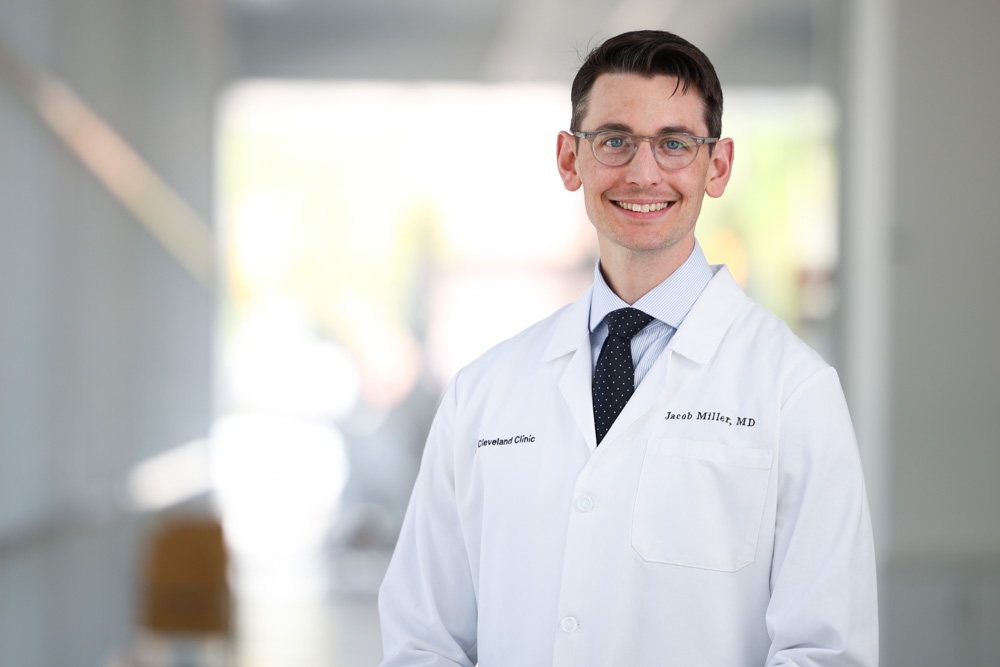
“This work wouldn't be possible without the VeloSano Pilot Grant. It really accelerates the pace at which we can introduce innovative technologies into the clinic and allows us to generate preliminary data for additional external funding.” - Jacob Miller, MD
For decades, patients with HPV‑associated throat cancer have faced the same demanding course of treatment: seven weeks of daily radiotherapy combined with chemotherapy. While cure rates are high, both the short-term and long-term side effects can significantly impact quality of life.
During and after treatment, patients commonly experience severe throat pain, difficulty swallowing, dry mouth, skin irritation, neck stiffness, lymphedema and dental problems. It’s rare, but some even experience a secondary cancer. Despite advances in care, the standard approach for this disease has not substantially changed in 30 years.
Jacob Miller, MD, a radiation oncologist at Cleveland Clinic, sees the toll of this protocol every day. Many of his patients are otherwise healthy individuals whose lives are suddenly interrupted by an intense regimen that can leave permanent effects. With support from a VeloSano Pilot Grant, Dr. Miller and his team are working to change that.
“This is one of the toughest courses of cancer treatment,” says Dr. Miller. “Our goal for this project is to maintain the same high cure rate while reducing the burden of treatment whenever it’s safe to do so.”
The key to achieving that goal lies in understanding how much oxygen is present within a tumor. Tumors with low oxygen levels — known as hypoxic tumors — are more resistant to chemoradiotherapy and require the full seven‑week regimen. Patients whose tumors are not hypoxic may be safely cured with as little as three weeks of treatment. A major challenge remains: there is currently not a clinically accessible or widely available method to measure hypoxia before and during treatment.
Dr. Miller and his team are pioneering a new approach. They have developed a dynamic, noninvasive blood test capable of detecting tumor hypoxia in real time. By analyzing cell‑free DNA collected from patients’ blood and tumor samples, the team has created a biomarker that could allow physicians to tailor treatment intensity to each patient.
“Instead of using a one-size-fits-all approach, we want to select patients based on hypoxia and then treat them differently,” says Dr. Miller. “Our translational research is fueled by what I witness in the clinic. This is personalized cancer medicine.”
For Dr. Miller, the work extends beyond scientific discovery. It’s also personal, as his own family has been affected by cancer. Since joining Cleveland Clinic in 2022, he has been an avid participant in Bike to Cure, an event that brings together cancer survivors, families, clinicians and community members around a shared mission.
“I’ve had family members treated for cancer at Cleveland Clinic, so fundraising for VeloSano is very meaningful to me,” says Dr. Miller. “It’s wonderful to see cancer survivors, families and colleagues come together for Bike to Cure, and we’re all focused on the same cause. We’re grateful for everyone who participates. We want to improve patient care, and VeloSano truly makes a difference.”

100% For The Cure

We use cookies to improve your browsing experience, analyze website traffic, and personalize content. By clicking “Accept All” you consent to our use of cookies. You can manage your preferences at any time. See our Privacy Policy.
We use cookies to run this site and, with your permission, to analyze traffic and personalize content. Choose which cookies to allow. See our Privacy Policy.
Required for the website to work. Always active.
Lets us measure website traffic and personalize content through Google Analytics. Nothing loads until you allow it.