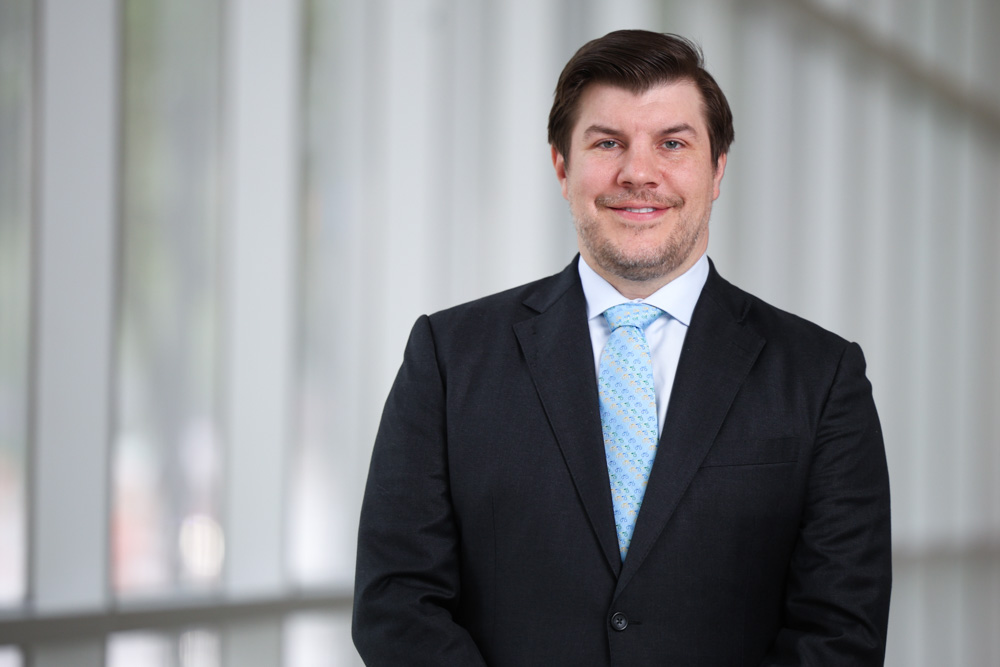
“VeloSano allows us to move quickly. This VeloSano Pilot Grant gives us the next step we need to take this project further and actually develop the evidence that we need. We couldn’t do that without this funding.”
Hepatocellular carcinoma (HCC), the most common type of liver cancer, is one of the fastest‑growing and deadliest cancers in the world. It is notoriously difficult to detect early, and many patients show no symptoms until the disease has already spread. Even when HCC is diagnosed, a significant number of patients do not respond well to the therapies currently available. It’s a daunting challenge but one Daniel Rotroff, PhD, and his team are currently taking on.
Dr. Rotroff, Chair of the Department of Quantitative Health Sciences and Eddie J. Brandon Endowed Chair for Diabetes Research at Cleveland Clinic, received a VeloSano Pilot Grant to investigate mRNA isoforms, the “versions” of mRNA that appear when DNA is converted into messages that make proteins. Some isoforms drive cancer growth, while others suppress it.
“These versions of mRNA don’t all work equally,” says Dr. Rotroff. “Our body uses them to regulate how we turn things on and off. This hasn’t been studied extensively in liver cancer, so we reanalyzed existing data and found isoforms that appear only in tumors, not in healthy tissue.”
Even more promising, Dr. Rotroff and his team detected these tumor‑specific isoforms in the blood of some HCC patients. When added to current screening tests, these markers could raise detection rates to nearly 80 percent, which is a major step forward for early diagnosis.
But detection is only half the story. Dr. Rotroff’s team has also developed splice‑switching oligonucleotides (SSOs) that shift harmful isoforms back toward their healthy versions. In early experiments, these SSOs slowed cancer cell growth. With VeloSano support, the team will now test these therapies in the lab, expand their search for additional targets using CRISPR tools and build the evidence needed to move toward first‑in‑human studies.
“I believe this project holds potential for both detection and therapy,” says Dr. Rotroff. “That’s pretty unusual to have something that covers both those spaces. We’re shifting to a blood test so that patients can come in for their clinical work and just draw an extra tube of blood.”
Dr. Rotroff is not only a past VeloSano Pilot Grant recipient; he’s also a dedicated Bike to Cure rider, motivated by the energy of all the people who come together each year united by a common cause.
“You can’t find anyone who hasn’t been touched by cancer,” says Dr. Rotroff. “Bike to Cure allows people to come together with a shared motivation to really move the needle in cancer treatment. The optimism is palpable — everyone’s super optimistic and believes this work will make a big difference.”

100% For The Cure
We use cookies to improve your browsing experience, analyze website traffic, and personalize content. By clicking “Accept All” you consent to our use of cookies. You can manage your preferences at any time. See our Privacy Policy.
We use cookies to run this site and, with your permission, to analyze traffic and personalize content. Choose which cookies to allow. See our Privacy Policy.
Required for the website to work. Always active.
Lets us measure website traffic and personalize content through Google Analytics. Nothing loads until you allow it.