“Without VeloSano, this study wouldn't be possible, so we're just beyond grateful for the support. It’s transformative.”
Leptomeningeal metastasis (LMM) is one of the fastest moving and most devastating complications of cancer. When cancer cells spread to the fluid and membranes lining the brain and spinal cord, patients can decline with alarming speed. During that time, hospitalizations become frequent, unpredictable and very disruptive to quality of life. Yet today’s standard of care relies on occasional MRIs and clinic visits, brief snapshots that often miss the rapid changes happening between appointments.
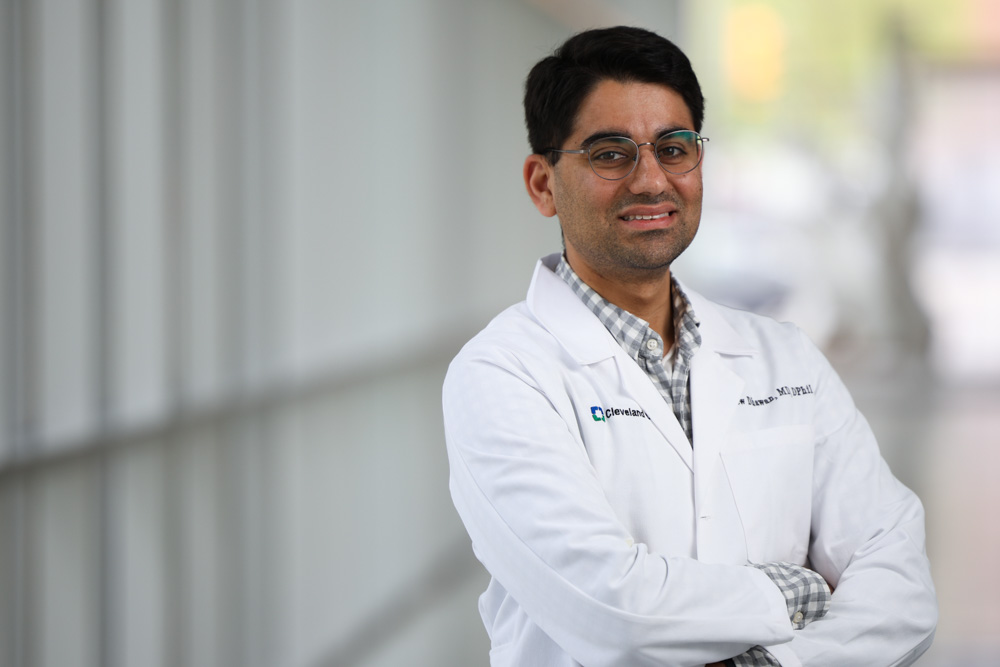
Andrew Dhawan, MD, DPhil, FRCPC, a neuro-oncologist at Cleveland Clinic, sees this firsthand in his patients. With support from a VeloSano Pilot Grant, he is leading an innovative study designed to shift LMM care from reactive crisis management to proactive, continuous monitoring. His team is building on a successful glioblastoma trial, using smartwatches and a custom‑built app to track subtle physiological changes in LMM patients in real time.
“It’s like a digital safety net for patients,” says Dr. Dhawan. “By measuring signals from wearable devices, we hope to generate patient‑specific signatures that alert patients and providers before a hospitalization is needed, so we can intervene earlier.”
The app monitors real‑time physiological signals, like step count, walking steadiness and heart rate. These subtle digital patterns, he believes, may reveal early signs of deterioration days or even weeks before symptoms become visible on a scan. For patients with LMM, that kind of early warning could be life‑changing.
“Understanding how we can use this technology to keep patients healthier, out of the hospital and aware when something is going awry is going to be incredibly valuable,” says Dr. Dhawan.
He and his team, with talented postdocs like Rowan Barker-Clarke, PhD, have developed a lot of expertise in wearable‑device research, but scaling the work required critical early seed funding. The VeloSano Pilot Grant arrived at a pivotal moment and is opening the door for them to gather data needed for larger funding opportunities.
“The VeloSano Pilot Grant is so valuable at this particular stage,” says Dr. Dhawan. “We have a number of amazing patients willing to participate and a fantastic team, but without funding, it’s hard to prime the system.”
His motivation comes from the people he treats, the colleagues he works alongside and the research he’s determined to advance. Each year, he channels that purpose by riding in Bike to Cure.
“Being at Bike to Cure reminds you why you’re doing this,” says Dr. Dhawan. “You see the patients and all the people who give so much to make this work possible. That’s why we pour our heart and soul into these projects.”

100% For The Cure

We use cookies to improve your browsing experience, analyze website traffic, and personalize content. By clicking “Accept All” you consent to our use of cookies. You can manage your preferences at any time. See our Privacy Policy.
We use cookies to run this site and, with your permission, to analyze traffic and personalize content. Choose which cookies to allow. See our Privacy Policy.
Required for the website to work. Always active.
Lets us measure website traffic and personalize content through Google Analytics. Nothing loads until you allow it.